 Round
Round Princess
 Oval
Oval Cushion
 Emerald
 Marquise
 Pear
Pear Radiant
 White Gold
 Yellow Gold
 Rose Gold
 Platinum
 Engagement Rings
 Black Gold
 Tungsten
 Platinum
 Two Tone
 Wedding Rings
 Fine Jewelry
 Diamond Studs
 Silver
 Up To 80% Off
 JAN | Garnet
 FEB | Amethyst
 MAR | Aquamarine
 APR | Diamond
 MAY | Emerald
 JUN | Pearl
 JUL | Ruby
 AUG | Peridot
 SEP | Sapphire
 OCT | Opal
 NOV | Citrine
 DEC | Topaz
 Find The Perfect Gift
How to Choose a Wedding Band That Fits Your Engagement Ring
Posted by Pompeii3 Inc on Oct 13, 2026
Choosing a wedding band should feel simple. It rarely is. The band has to sit flush against your engagement ring, match the metal, complement the setting style, and still feel comfortable years from now. Get one element wrong and the stack looks unbalanced or the rings fight for space on your finger.
This guide walks through every variable that affects how a wedding band pairs with an engagement ring, from profile shape and metal type to setting compatibility and width. Whether you have a solitaire, a halo, or a vintage pave ring, the right band is out there. You just need to know what to look for.
Why "Flush Fit" Matters More Than You Think
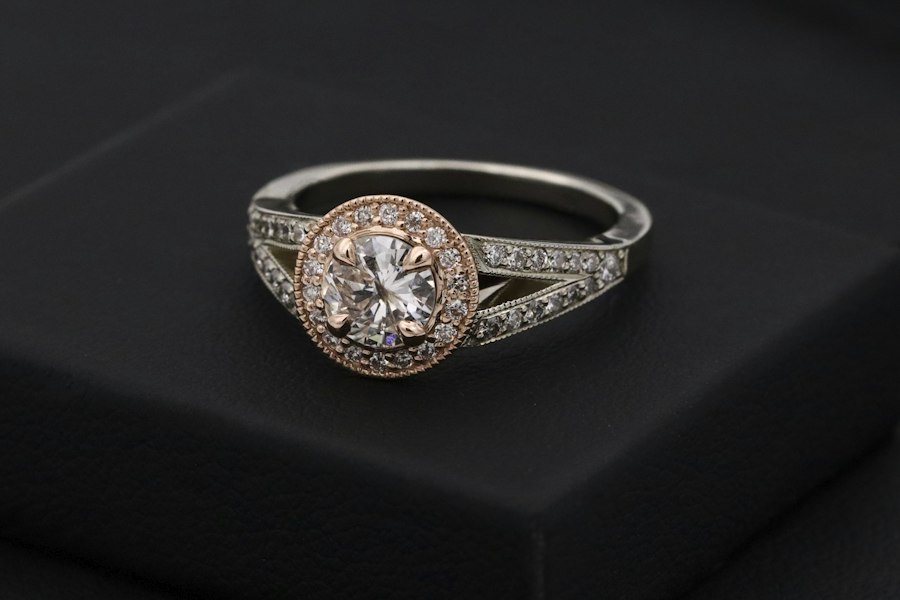
A wedding band that sits flush with your engagement ring means there is no visible gap between the two rings when they stack together on your finger. This matters for two reasons: appearance and comfort. A gap creates a pinching zone that traps skin and soap, and it makes the stack look incomplete rather than intentional.
The profile of your engagement ring determines what flush fit means in practice. A solitaire with a straight, flat base pairs easily with a standard flat band. A ring with a wide pave shank, a split shank, or a cathedral setting has a raised profile at the bottom, which means a standard flat band will leave a gap. The solution in those cases is a contour band, also called a curved or shadow band, shaped to hug the exact silhouette of your center stone setting.
Before shopping, look at your engagement ring from the side. If the underside of the shank is flat and level, almost any band will flush. If the underside curves up toward the center stone, you need a contour or custom-fit band to close that gap cleanly.
Band Profile Types: Flat, Contour, and Curved
Three profile types cover the majority of wedding band pairings:
Flat bands work best with engagement rings that have a flat shank profile, including most classic solitaires, bezel settings, and tension settings. They are the easiest to stack, the most versatile over time, and the simplest to resize if needed. A flat band in the same metal as your engagement ring can look minimal and elegant.
Contour bands are designed with a notch or curve that wraps around the center stone or prongs of a specific ring style. They eliminate the gap that a flat band would leave against a halo, cathedral, or marquise setting. Some jewelers offer universal contour cuts in a few standard depths; others design them to match specific rings exactly. Pompeii3 bridal sets are designed so the band already matches the engagement ring profile out of the box.
Curved or chevron bands are a variant of contour bands with a V-shape or arch. They work well with pear, marquise, and oval engagement rings where the center stone has a pointed or elongated outline. They also create a stacking look that reads as one intentional unit rather than two separate rings.
Matching Metals: Same, Mixed, or Two-Tone
The safest rule is to match the metal of your wedding band to the metal of your engagement ring shank, not the prongs. If your ring has a white gold or platinum shank with yellow gold prongs, match the band to the shank. Mismatched metals tend to look unintentional up close.
That said, mixed metal stacking has become a deliberate style in its own right. A yellow gold band next to a white gold engagement ring creates contrast, and many buyers intentionally mix to signal individuality. If you are going mixed, commit fully by choosing metals at least two tones apart so it reads as a design choice rather than an accident.
One practical note: platinum and white gold look nearly identical but wear differently. Platinum develops a patina over time that softens its surface. White gold stays brighter but requires occasional rhodium plating. If your engagement ring is platinum, a white gold band will diverge in finish after a few years. Consider matching metal families, not just colors, for a consistent look long-term.
Width and the Finger Balance Test
Wedding band width is measured in millimeters and typically runs from 1.5mm to 8mm for women's bands. The right width depends on two things: the width of your engagement ring shank and your finger size.
A common guideline is to match or go slightly narrower than your engagement ring shank. If your ring has a 2mm shank, a 1.5mm to 2mm band maintains visual balance. If your ring has a wider, statement shank at 3mm or more, you can go up to match it without the band overpowering the center stone.
Finger width plays a role too. On a narrower finger, a 4mm band can dominate the hand and make the engagement ring look crowded. On a wider finger, a 1.5mm band can look lost next to a bold solitaire. Try multiple widths on before committing, even if you are buying online, using a ring sizer and referencing the visual guides most jewelers provide by finger size.
| Engagement Ring Style | Best Band Type | Flush Fit? | Notes |
|---|---|---|---|
| Classic solitaire (flat shank) | Flat or plain band | Yes | Most versatile pairing option |
| Halo setting | Contour or curved band | Only with correct contour | Flat band leaves a visible gap |
| Cathedral or raised setting | Contour band | Only with correct contour | Gap at base is most pronounced here |
| Pave or split shank | Narrow flat or diamond band | Yes (if shank is straight) | Keep band width narrower than shank |
| Marquise or pear center stone | Chevron or V-shaped band | Yes | Accentuates the elongated shape |
| Three-stone ring | Contour or slim flat band | Only with correct contour | Side stones often create a raised profile |
| Vintage or art deco setting | Milgrain or filigree band | Usually yes | Match the detailing style of the ring |
| Bridal set (ring + band designed together) | Included matching band | Guaranteed | Simplest solution for a perfect flush fit |
The Case for a Bridal Set
If you are still in the engagement ring selection phase, a bridal set is the most reliable way to guarantee flush fit. A bridal set includes the engagement ring and matching wedding band designed as a unit. The band is contoured or sized to sit perfectly against the engagement ring without any measuring, guessing, or custom work required.
Bridal sets also save money compared to buying the two pieces separately from different collections. The trade-off is flexibility: the band is designed for that ring specifically, so if you want to stack additional bands later or swap out the engagement ring, you are working around a matched pair.
For buyers who want a clean, unified look with zero guesswork, a bridal set is the answer. Browse Pompeii3 bridal sets to see engagement rings with their matching bands already paired.
Diamond Wedding Bands vs. Plain Metal Bands
A diamond wedding band adds sparkle and weight to the stack. A plain metal band keeps the focus on the center stone and reads more minimal. Neither is objectively better. The right choice comes down to your engagement ring and the visual outcome you want.
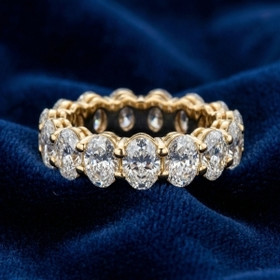
If your engagement ring already has heavy pave or side stones, a plain band prevents the stack from competing with itself. If your engagement ring is a simple solitaire, a diamond band can bring the total look up without overwhelming the center stone. A single row of diamonds along the band, called a diamond eternity or half-eternity band, is the most common choice for adding sparkle without bulk.
Width and stone size matter here too. A thin band with small pave diamonds reads subtle and feminine. A wider channel-set band with larger diamonds makes a bolder statement and can alter how the engagement ring looks in the stack. Try both on a mock-up image or in person before deciding.
How to Shop Online for a Wedding Band That Fits
Shopping for a wedding band online when you already own an engagement ring requires a few extra steps compared to buying both from a bridal set.
First, measure the width of your engagement ring shank. This is the band portion below the head, not the widest part of the setting. Use a ruler or digital calipers if you have them, or ask your original jeweler for the measurement.
Second, identify your engagement ring profile from the side view. Take a photo from straight-on at finger level. If the base of the ring curves up before meeting the finger, you need a contoured band. If it lies flat against the skin, a standard flat band will flush properly.
Third, check the metal type and color. Confirm whether your engagement ring is 14k or 18k gold, and match the karat if possible. Mixing 14k and 18k of the same color metal can create a slight tone variation under certain lighting.
If you are unsure, Pompeii3's team can help match a wedding band to an existing engagement ring. Browse the full wedding band collection and use the filter tools to narrow by metal, width, and style.
Find Your Perfect Wedding Band
Shop Pompeii3's full selection of wedding bands and bridal sets designed to stack and sit flush with your engagement ring.
Shop Wedding Bands Browse Bridal SetsWedding Band Compatibility Finder
Answer four quick questions to find wedding band styles that may suit your engagement ring.
What type of engagement ring do you have?