 Round
Round Princess
 Oval
Oval Cushion
 Emerald
 Marquise
 Pear
Pear Radiant
 White Gold
 Yellow Gold
 Rose Gold
 Platinum
 Engagement Rings
 Black Gold
 Tungsten
 Platinum
 Two Tone
 Wedding Rings
 Fine Jewelry
 Diamond Studs
 Silver
 Up To 80% Off
 JAN | Garnet
 FEB | Amethyst
 MAR | Aquamarine
 APR | Diamond
 MAY | Emerald
 JUN | Pearl
 JUL | Ruby
 AUG | Peridot
 SEP | Sapphire
 OCT | Opal
 NOV | Citrine
 DEC | Topaz
 Find The Perfect Gift
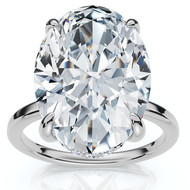
Oval Cut Engagement Ring Guide: What Buyers Should Know
Posted by Pompeii3 Editorial Team on Sep 25, 2026
Oval cut engagement rings have been the most searched diamond shape for three consecutive years. That is not a passing trend — it is buyers discovering that oval gives more ring for the money, a flattering elongating effect on the finger, and a silhouette that stands apart from round without requiring an unusual taste. But the buyers arriving at an oval ring do not always arrive informed. The bow-tie effect, the length-to-width ratio, the way the setting changes the look — these are practical details that separate a confident purchase from a regretted one. This guide covers everything you need to know before you buy.
Why Oval Cut Engagement Rings Are Trending
Three things are driving the oval's rise: the elongating effect, the face-up size advantage, and the price gap versus round. None of them are minor details.
An oval diamond sits lengthwise across the finger. This visual line makes the finger appear longer and more slender — a consistent preference among buyers that round diamonds, by their nature, cannot replicate. At the same carat weight, an oval diamond also appears 5 to 10 percent larger than a round brilliant because the oval spreads across a greater surface area of the stone. For buyers comparing stones at the same price, that size difference is visible.
The price advantage is the most concrete point. Oval diamonds cost 15 to 25 percent less than round brilliant diamonds of the same carat weight, cut quality, color, and clarity. Round brilliants carry a premium because they are the most in-demand shape and require cutting from a larger portion of the rough stone. Oval uses the rough more efficiently. That gap translates directly into getting a larger or higher-quality stone at a given budget.
The result is a shape that gives buyers a distinctive silhouette, a larger-looking stone, and meaningful savings — without any real trade-off in brilliance or durability.
The Bow-Tie Effect: What It Is and How to Avoid It
The bow-tie effect is the most discussed concern with oval diamonds, and it deserves a clear explanation. When you look straight down through the table of an oval diamond, you may see a dark shadowed band across the width of the stone — shaped like a bow tie. This is not a defect or a grading flaw. It is an optical effect that results from the geometry of the oval shape.
Every oval diamond has some degree of bow-tie. The question is how visible and how distracting it is. A well-cut oval minimizes the bow-tie to the point where it adds depth without pulling the eye. A poorly cut oval has a prominent, dark bow-tie that breaks the stone's brilliance and makes it look dull across the center.
The bow-tie is not captured in a grading report. The GIA, IGI, and AGS reports for an oval diamond will tell you the cut grade, but they will not measure the bow-tie effect specifically. This means you cannot rely on a certificate alone when shopping for an oval.
When viewing a stone, tilt it slightly as you watch the video. A good oval will maintain brightness across the center even as the viewing angle shifts. One where the center goes very dark when tilted has a pronounced bow-tie that will show in regular wear.
Length-to-Width Ratio: The Detail That Changes Everything
The length-to-width ratio is the measurement that determines how elongated or how round an oval diamond appears. Most buyers do not know this specification exists until after they have looked at two stones that share the same carat weight but look completely different. The ratio explains that difference.
The ratio is calculated by dividing the length of the stone by its width. A ratio of 1.00 would be a perfect circle. A ratio of 1.50 means the stone is 50 percent longer than it is wide. Oval diamonds sold for engagement rings typically range from 1.20 to 1.70.
The most common recommendation across jewelers and buyers is the 1.35 to 1.50 range. This window gives a clearly oval shape with meaningful elongation without the stone looking stretched or narrow. A 1.40 ratio is often cited as the most versatile single ratio — balanced between classic and modern, and suited to most hand types.
If the buyer has shorter fingers, a ratio toward the higher end of the sweet spot (1.45 to 1.50) will do more work visually. If the buyer prefers a slightly more rounded shape, 1.35 to 1.38 gives a softer oval that sits closer to a round in proportions without losing the oval character.
Oval vs. Round Brilliant: The Real Buyer Decision
Most buyers narrowing down to an oval have spent time looking at rounds. The comparison is worth making directly.
| Factor | Oval Cut | Round Brilliant |
|---|---|---|
| Brilliance | High — excellent light return in a well-cut stone | Highest — the most optimized cut for light performance |
| Face-up size | 5–10% larger appearance per carat | Standard reference point |
| Price (same specs) | 15–25% less than round | Higher — carries a market premium |
| Finger effect | Elongating — visually lengthens the finger | Neutral — centered symmetrical look |
| Bow-tie concern | Yes — must evaluate stone-by-stone | None |
| Setting flexibility | Solitaire, halo, East-West, cathedral | Universal — works in any setting |
| Uniqueness | Trending but distinctive — stands apart from round | Most common shape — classic and timeless |
Round brilliant is still the most popular engagement ring shape in total units sold. It is the safest choice for maximizing light performance and choosing something universally recognizable. But buyers who want a larger-looking stone at a given price, a ring that elongates the finger, and a silhouette that is recognizably different from most rings on the hand — oval delivers on all three, for less money.
The one area where round wins clearly is brilliance. The round brilliant cut is engineered specifically to maximize light return, and no other shape matches it on pure sparkle. The difference in well-cut stones is smaller than most people expect — a well-cut oval with minimal bow-tie holds its own in most lighting — but if maximum brilliance is the single deciding factor, round wins.
Best Settings for an Oval Engagement Ring
Solitaire
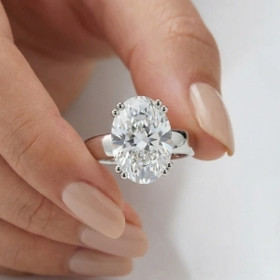
The solitaire is the most popular setting for oval diamonds. Four or six prongs hold the stone above the band with nothing competing for attention. A four-prong solitaire shows the maximum amount of the diamond surface. A six-prong version provides slightly more security, which matters if tip protection is a priority. The solitaire suits any hand type and any style preference because the diamond is the only statement being made.
Halo
A halo setting surrounds the center oval with a row of smaller diamonds, typically micro-pave. The effect is two things simultaneously: the center stone appears 10 to 20 percent larger visually, and the tips of the oval are naturally protected by the setting. For buyers who want more presence per dollar or who are concerned about exposed tips, a halo is the strongest functional choice. The trade-off is that a halo requires more maintenance over time — the small surrounding stones can loosen.
East-West (Horizontal)
An East-West setting rotates the oval 90 degrees so it sits horizontally across the finger rather than vertically. This gives a contemporary, architectural look that reads very differently from a traditional engagement ring. It also tends to suit wider fingers more than the vertical oval because the horizontal stone does not reinforce the finger width as strongly. East-West oval rings have gained significant traction among buyers who want something recognizably unconventional without going into unusual diamond shapes.
Cathedral and Vintage-Inspired
Cathedral settings raise the center stone above the shank on arching metal supports. For an oval diamond, this adds presence and draws the eye upward to the stone. Vintage-inspired settings — milgrain edges, filigree work, engraved bands — pair well with oval's slightly romantic silhouette and suit buyers whose style runs toward older aesthetic references rather than modern minimalism.
Pave Band
Adding a pave band to a solitaire oval is the most common upgrade buyers make after choosing the center stone. A row of small diamonds running along the shank adds sparkle that frames the center stone without competing with it. This works well with any of the settings above and adds visual weight to the ring without substantially changing the overall design.
Oval Cut Diamond Pricing: What to Expect
The price gap between oval and round is real and consistent. Across the 0.75 to 2.0 carat range where most engagement ring diamonds are purchased, ovals run 15 to 25 percent below equivalent round brilliants. At a 1.0 carat purchase with a $5,000 budget for the center stone, that gap represents a meaningful quality or size upgrade. A buyer who would have purchased a 1.0 carat round at F/VS2 could instead purchase a 1.2 carat oval at the same quality grade for roughly the same price.
Lab-grown oval diamonds extend that advantage further. A lab-grown oval diamond costs 50 to 80 percent less than a mined oval of the same specifications. At a $3,000 budget for a center stone, the difference between a mined oval and a lab-grown oval at the same quality grade can be two full carat weights. The stone looks identical — lab-grown diamonds are chemically and optically the same as mined diamonds — but the price gap is significant enough to affect how a buyer approaches the overall ring budget.
What to Look for When Buying an Oval Diamond Online
The oval sensitivity to cut quality means a certificate is necessary but not sufficient. Here is what to verify before purchasing.
- Grading certificate: GIA, IGI, or AGS certified only. The certificate confirms carat weight, color, clarity, and dimensions, but not cut grade for fancy shapes — this must be evaluated visually.
- Video of the stone: Not a still photo under spotlight — a rotating video in multiple lighting conditions. This is the only reliable way to evaluate the bow-tie effect online.
- Length-to-width ratio: Confirm the ratio falls between 1.35 and 1.50 unless you have a specific preference outside that range. Calculate it from the millimeter measurements in the listing if not stated explicitly.
- Setting that covers the tips: A four or six-prong solitaire, a halo, or a bezel that wraps the long ends of the oval stone protects the most vulnerable points of the cut.
- Color grade: Oval diamonds tend to show color more readily than rounds because the elongated shape concentrates color toward the tips. G or H color grade in white gold or platinum will typically face up white. In yellow gold, H or I is acceptable.
- Clarity: SI1 or better. Inclusions that are eye-clean at SI1 in a round may be more visible in an oval, particularly near the tips — confirm eye-clean status with the retailer before purchasing.
Frequently Asked Questions
What is the bow-tie effect in an oval diamond?
The bow-tie effect is a dark shadow that appears across the center of an oval diamond, shaped like a bow tie. It happens when light leaks out of the stone rather than reflecting back to the eye. Every oval diamond has some degree of bow-tie — the goal is choosing one where it is minimal and not distracting. Always view an oval diamond in video or under multiple lighting conditions before buying online.
What is the best length-to-width ratio for an oval engagement ring?
The most widely preferred length-to-width ratio for oval diamonds is between 1.35 and 1.50. A ratio of 1.35 gives a slightly rounder, more subtle oval shape. A ratio of 1.50 gives a more elongated, classic oval look. Ratios below 1.30 start to look nearly round. Ratios above 1.60 begin to look very narrow and long, which suits some buyers but not most.
Is an oval cut diamond cheaper than a round brilliant?
Yes. Oval cut diamonds typically cost 15 to 25 percent less than a round brilliant diamond of the same carat weight, cut quality, color, and clarity. This is partly because round brilliants are cut from a larger portion of the rough stone and carry a premium for their dominance in the market. Lab-grown oval diamonds extend that savings gap significantly further.
What settings work best with an oval engagement ring?
The most popular settings for oval diamonds are solitaire (four or six prongs), halo, and East-West. A solitaire lets the oval shape speak on its own. A halo adds visual size and protects the stone pointed tips. An East-West setting rotates the oval horizontally for a more modern look. Cathedral and vintage-inspired settings also pair naturally with oval romantic silhouette. Pave bands are a strong add-on to any of these styles.
How does an oval cut compare to a round brilliant for everyday wear?
Both shapes are equally durable for everyday wear. The main practical difference is the two slightly pointed tips on an oval diamond, which benefit from prong or bezel coverage to prevent chipping over time. A four or six-prong setting that secures the tips is standard for most oval settings. Round brilliant diamonds require no tip protection. Both shapes hold up well in bezel, prong, and halo settings for daily wear.
Does an oval diamond look good on short fingers?
Yes — this is one of the oval strongest advantages. The elongated shape creates a visual line that makes the finger appear longer and more slender. For shorter fingers, an oval set vertically with a ratio of 1.40 to 1.50 will do the most to enhance finger length. East-West settings, which orient the oval horizontally, are better suited to longer fingers.